
Why Slow Thinking (and Slow Writing) Can Be Good for You
By Celeste Ng
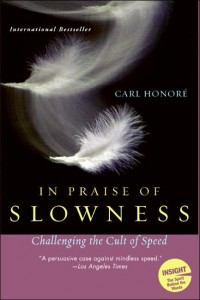
A while back, Anne blogged about J. Robert Lennon and the argument that writers are really working all the time. Here’s further reason to back away from the writing schedule and cut yourself some slack now and then. Carl Honore, author of In Praise of Slowness, makes a compelling case for “slow thinking” when it comes to finding new ideas:
[...] Slow Thinking is intuitive, woolly and creative. It is what we do when the pressure is off, and there is time to let ideas simmer on the back burner. It yields rich, nuanced insights and sometimes surprising breakthroughs.
Research has shown that time pressure leads to tunnel vision and that people think more creatively when they are calm, unhurried and free from stress and distractions. We all know this from experience. Your best ideas, those eureka moments that turn the world upside down, seldom come when you’re juggling emails, rushing to meet the 5pm deadline or straining to make your voice heard in a high-stress meeting. They come when you’re walking the dog, soaking in the bath or swinging in a hammock.
Sure, we know that some downtime is important, but we usually feel obliged to justify any time spent Not Being Productive–to our bosses at our day jobs, to skeptical relatives and friends, even to ourselves. Perhaps it’s an artifact of the Puritan work ethic: if you’re not producing, you’re doing something wrong (and you should be ashamed of being so immoral). This is a helpful reminder that an hour spent daydreaming, cooking, or wandering–or reading blogs–might actually be productive after all.
How do you get yourself to slow down and make time for that Slow Thinking?
Read more here.




“Here’s further reason to back away from the writing schedule and cut yourself some slack now and then.”
Hmm. Maybe—as long as it’s only “now and then.” Really, though, I think adhering to a writing schedule has actually helped me perform the kind of slow thinking you describe here. For me at least, the key has always been establishing a routine: knitting the hours I spend writing into the repeated pattern of my days.
Honore’s right when he talks about the damaging effects of time pressure (many of us have hustled to complete stories in order to meet workshop deadlines, for example). But in my experience, breaking away from my writing routine—spending less time writing, in other words—has nearly always proven counterproductive. I try to avoid time pressure by making sure I give myself plenty of time, and I make sure I’m giving myself plenty of time by carving out hours from every single day to write, and by adhering to this routine. When the going gets tough on any particular day, I (usually!) remain unconcerned because I know that there will be more hours for me to work things out tomorrow, and the day after that, and so on. I think that if I treated my writing schedule as something optional, I’d feel more pressure—if my writing sessions were less regular, I’d feel a greater need to produce in each particular one.
This isn’t to say that daydreaming, wandering, and blog-reading aren’t also important (I’m here now, after all, typing this—though that’s only because I’ve already put in my writing hours this morning, and because I know I’ll write again this evening)—but I think I’m able to spend my downtime with less anxiety when I know that I have a steady stream of writing time ahead of me to explore whatever ideas bubble up on my brain’s back burner.
Of course, this is all coming from someone who adores routine and despises surprises, so add your pinch of salt.
Greg, you make an excellent point. There’s much to be said both for having a writing routine and, actually, for having a regular “day job” that frames your writing time. In writing this post I really wanted to work in this excellent essay from the Millions, “Working the Double Shift,” which discusses finding a balance between writing and non-writing time.
I think we’re actually not that far apart: what we’re after is balance. Writing constantly, with no down time for “slow thinking,” would probably lead to frustration and stagnation. On the other hand, too much daydreaming and blog-reading–as you point out–would probably be counterproductive as well. We need both in there, and the exact proportions are probably a matter of individual preference.
I see Honore’s larger point as not necessarily “Spend less time writing” but rather “Be sure to take some time for slow thinking.” Or here’s another way to look at it: Maybe some of that daydreaming, wandering, and blog-reading is actually productive time–necessary gestation time for the things you’ll get down on paper when you do sit down to write.
[...] Read more about Five Chapters and other serial fiction and why slow might be good for you [...]
[...] Why Slow Writing (and Slow Thinking) Can Be Good for You [...]
[...] slow thinking (and writing) can actually be good for [...]