
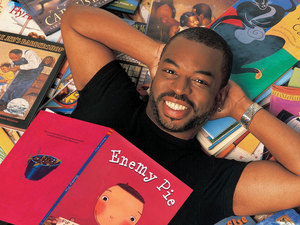
photo: GPN/Nebraska ETV Network and WNED Buffalo

photo: GPN/Nebraska ETV Network and WNED Buffalo

Apparently getting kids excited about books isn’t worth funding. It’s better to focus on the “mechanics” of reading because, you know, that will definitely instill the next generation with a passion for it. **head explodes**

Via NPR:

The show’s [26-year] run is ending, Grant explains, because no one — not the station, not PBS, not the Corporation for Public Broadcasting — will put up the several hundred thousand dollars needed to renew the show’s broadcast rights.

Grant says the funding crunch is partially to blame, but the decision to end Reading Rainbow can also be traced to a shift in the philosophy of educational television programming. The change started with the Department of Education under the Bush administration, he explains, which wanted to see a much heavier focus on the basic tools of reading — like phonics and spelling.

Grant says that PBS, CPB and the Department of Education put significant funding toward programming that would teach kids how to read — but that’s not what Reading Rainbow was trying to do.

“Reading Rainbow taught kids why to read,” Grant says. “You know, the love of reading — [the show] encouraged kids to pick up a book and to read.”

Linda Simensky, vice president for children’s programming at PBS, says that when Reading Rainbow was developed in the early 1980s, it was an era when the question was: “How do we get kids to read books?”

Since then, she explains, research has shown that teaching the mechanics of reading should be the network’s priority.


3 responses to “Reading Rainbow snuffed out by short-sighted, phonics-loving imagination killers”

  1. Celeste says:

    Anne, thanks so much for posting this. This boggles my mind too: we want to teach kids HOW to read, but we don’t care if they enjoy it or find it important? That turns reading into an abstract, school-time-only skill, rather than an enrich-your-life skill.

    Interestingly, we’re taking the complete opposite stance in math. The emphasis now is on teaching math skills in context–translation: word problems–so that kids see math as not an abstraction but something integral to everyday life. I’m all in favor of that, but why are we treating reading so differently?

  2. Jes says:

    So sad, I was definitely one of those kids in the early 80’s who was in the thrall of “Reading Rainbow” it was a dream of mine to be one of the kid reviewers who got to describe and recommend a book at the end of the show.

    Along similar lines to what Celeste mentioned about getting students to “get” reading in a way that makes them excited, there was an interesting article in the NYT about a new middle/high school workshop approach to English classes. It profiled on teacher in Georgia who seems to be having some success with letting students choose which books they read. I still think there’s something to be said for at least some sort of a common body of knowledge, but also think self-direction is a powerful motivator. As the article suggests, perhaps some hybrid approach is needed.

  3. Dianna says:

    Iiinteresting. And depressing. We’re just starting to address phonics vs. whole language learning in my literacy class, and it seems like this attitute actually takes several steps back in pedagogy. Why don’t we start using dunce caps and hickory sticks again, too?

    God I love that song.

Comment