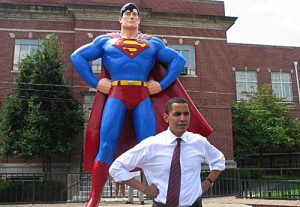
 One year after President Obama’s inauguration, everyone seems to have either criticism or advice for his administration–for pushing health care reform; for not yet passing health care reform; for not waving his magic wand to fix the economy, eradicate H1N1, and end both wars; for not leaping tall buildings in a single bound. But author Junot Diaz points out a different problem in an an essay in the New Yorker: President Obama’s lack of storytelling since his election.
All year I’ve been waiting for Obama to flex his narrative muscles, to tell the story of his presidency, of his Administration, to tell the story of where our country is going and why we should help deliver it there. A coherent, accessible, compelling story—one that is narrow enough to be held in our minds and hearts and that nevertheless is roomy enough for us, the audience, to weave our own predilections, dreams, fears, experiences into its fabric. […] But from where I sit our President has not even told a bad story; he, in my opinion, has told no story at all. I heard him talk healthcare to death but while he was elaborating ideas his opponents were telling stories. Sure they were bad ones, full of distortions and outright lies, but at least they were talking to the American people in the correct idiom: that of narrative. The President gave us a raft of information about why healthcare would be a swell idea; the Republicans gave us death panels. Ideas are wonderful things, but unless they’re couched in a good story they can do nothing.
What do you think? Is Diaz on to something here? Is the lack of presidential narrative part of what’s hampering Obama?