We live on the edge of a continent. Our world teeters between land and sea, washed in whimsical coastal weather. Here, cusp is truth. Liminal is how things are, and the World is a story we make up. And tear down. And make up again.
What an awesome and terrifying idea: novelist Silvia Hartmann will write her next novel live on Google Docs and let anyone who wants to follow along—and send her feedback on her work. (Via.) Hartmann explains in a press release on her website: This project, known as “Hartmann Book Live” aims to go one step further and give fans the chance to not only see the manuscript being typed, but to also comment on the storyline and provide feedback as the novel develops. […] On Wednesday, 12th September at 9am the author will let her social network followers know […]
Fiercely protective of his writing time, Joshua Cohen (Four New Messages) makes no apologies for keeping his interview answers pithy: “The book is the oil painting above the grand piano of the future. Certain households have them. We/they know who they are.”
Writers are full of tricks to get themselves to actually WRITE. We’ve covered a lot of them here on FWR: positive reinforcement (with tools like Written? Kitten!, which rewards you with photos of cute cats), fear (with apps like Write or Die, which plays annoying noises—or deletes your work!—if you stop writing), and flat-out self-blackmail. Here’s yet another addition to your arsenal, O Writer In Need Of Motivation. A new program, Blockr, lets you set goals and blocks you from the internet until you’ve completed them. Says the Blockr site: Today, the sirens we face are glowing rectangles. As Odysseus […]
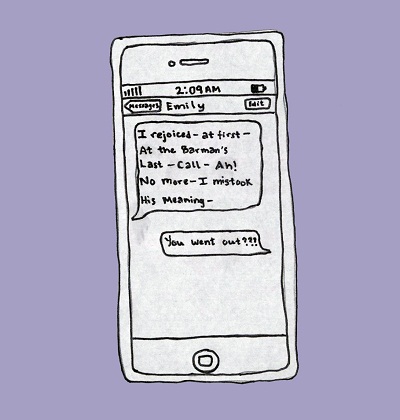
I get a childish delight out of anachronistic mashups, so the Paris Review’s drunk texts from Gertrude Stein, Emily Dickinson, William Wordsworth, and more are right in my wheelhouse: Read the full set on the Paris Review‘s site. Meanwhile, on The Hairpin, Mallory Ortberg imagines texts from Jane Eyre–the character: JANE WHERE HAVE YOU GONE I AM BEREFT AND WITHOUT MY JANE I SHALL SINK INTO ROGUERY i am with my cousins WHICH COUSIN IS IT THE SEXY ONE Please don’t try to talk to me again IT IS YOUR SEXY COUSIN “ST. JOHN” WHAT KIND OF A NAME IS […]
I just finished teaching for the term, and this past class was a bit unusual: I had two legally blind students. All of my students were phenomenal, but I was particularly floored by the dedication of those two—one of whom did the class reading by listening to his computer read the stories aloud. This all got me thinking about the many things I take for granted, including the ability to stare at a blank page waiting for inspiration to strike. Voice recognition software has come a long way, but it’s still not the smoothest tool for writers, as novelist Justine […]
Not long ago, we talked about the phenomenon of robots writing books. But those computer-authored tomes—with scintillating subject matter like Saltine Cracker were mish-mashes of text culled together from Wikipedia and other websites. Computers can’t write actual stories. Or can they? Enter Narrative Science, a Chicago-based software company teaching computers to do just that—well, news stories, at least. Wired explains that articles written by the company’s computer algorithm are already out there: The computer-written product could be a pennant-waving second-half update of a Big Ten basketball contest, a sober preview of a corporate earnings statement, or a blithe summary of […]
Perhaps, like many of us, you’re the kind of person who won’t do anything without a (proverbial) gun to your head. But it’s hard to type while holding a gun to your own head, no? Leave it to technology to solve this problem: enter Aherk!, which describes itself as a free “goal-oriented self-blackmailing service.” Now in beta testing, Aherk! has three basic steps: Define a goal. Tell us what it is that you want to achieve and set a deadline. Put your ass on the line. Upload a compromising picture that will be posted to Facebook in case you fail […]
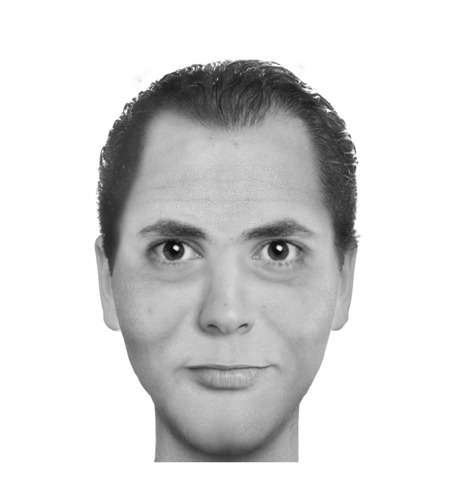
Like most readers, you probably have your own mental image of Humbert Humbert, or Emma Bovary, or the Misfit. But if you’re the kind of person who likes a visual, check out The Composites, a Tumblr site that plugs literary descriptions of characters into police composite sketch software. The results are… well, take a look below and decide for yourself. Here’s how the police sketch program portrayed the three characters I mentioned above, along with the passages that generated them. (All images via The Composites.) Humbert Humbert, from Lolita by Vladimir Nabokov: Gloomy good looks…Clean-cut jaw, muscular hand, deep sonorous […]