
Suspend Your Disbelief

Archive for 2010

Shop Talk |

How to Cope with the Writing Life

Author Hannah Moskovitz has a sweet little post on coping with the ins and outs of a daily writing life: Here’s what I’ve found keeps you from getting gnawed down to nothing with the jealousy, fear, and guilt that seems to go hand in hand with writing. Tell someone who isn’t a writer. When I was querying in high school, I had a few people ask me why the fuck I kept running to the computers like an addict between every class. So I explained querying to them, with a flow-chart. All paths lead to rejection–query, partial, full–except this one […]



Shop Talk |

20 Under 40, 10 Over 80, and 20 More Under 40 (40 Years Ago)

Time for age-based writer lists! First up: The New Yorker names its list of “20 under 40” list of fiction writers worth watching. The last such list was compiled in 1999 and included Jhumpa Lahiri, Junot Diaz, and David Foster Wallace; the current list includes Sarah Shun-Lien Bynum, Joshua Ferris, Salvatore Scibona, and Wells Tower, among many others. Yes, all of them were born in 1970 or later. If that bothers you, move on to list #2: Ward Six counters the New Yorker list with a list of “10 Great Writers Over 80,” praising John Barth, Beverly Cleary, Harper Lee, […]


Shop Talk |

Twitter-ary Analysis

Still not convinced that “Twitterature” is an actual art form? TIME magazine’s James Poniewozik has put together the most compelling analysis of Twitterfiction I’ve seen yet: Like any other kind of literature, Twitter lit — or Twitterature, to borrow the title of a recent book that condensed literary classics into tweet form — has its strengths, rules and tropes. Twitter is pure voice, an exercise in implying character through detail and tone. Halpern’s inaugural @shitmydadsays tweet is so economical that it should be taught in writing workshops: “‘I didn’t live to be 73 years old so I could eat kale. […]


Shop Talk |

The Library of America's Story of the Week

Each week, The nonprofit Library of America offers a free short story, readable online in PDF form. The current “Story of the Week” is “The Charmed Life”< by Katherine Anne Porter. Other recent features include “Charles” by Shirley Jackson (who—yes!—wrote more than just “The Lottery”), the early story “The Cut-Glass Bowl” by F. Scott Fitzgerald, and The Wives of the Dead” by Nathaniel Hawthorne. Each story is also accompanied by some commentary that helps set the story in context. This seems like a great—and free—way to discover some lesser-known pieces by well-known American writers. See the current story and all […]


Shop Talk |

CLMP's 11th Annual Lit Mag Marathon Weekend

NYC-based readers: On June 19-20, check out the CLMP’s Lit Mag Marathon Weekend, an annual celebration, showcase, and discount extravaganza of literary magazines and journals. – Events kick off on Saturday at 4 PM with The Magathon at the New York Public Library (main branch: Fifth Ave @ 42nd Street). For 2.5 hours, a number of journal editors will present favorite selections from their latest issues. – Then on Sunday from noon to 5, get your discounted periodical fix at the 11th Annual Literary Magazine Fair (also known as the Giant Lit Mag Fair) at Housing Works Bookstore Café (126 […]


Shop Talk |

"This Book Made Me Want to Die"

Here’s a great blog post from FWR favorite Aryn Kyle, on writing “happy literature”: “You should write something happy,” people tell me, and I don’t understand. Happy like Anna Karenina? Happy like The Grapes of Wrath? Happy like Lolita or Catch-22 or Revolutionary Road? Happy like Hamlet? What, I’d like to ask people, are these “happy books” you speak of, and who is writing them? I was an English Literature major, for sobbing out loud! I’ve never read a happy book in my whole life! Unless you count Jane Austen, who could usually be depended on to wrap things up […]


Interviews |

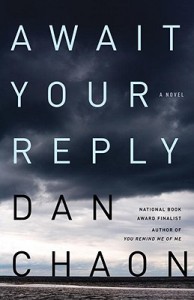
Unanswered Questions: An Interview with Dan Chaon

“I’ve always felt personally and emotionally closer to the searchers, rather than to the finders…to those who don’t get answers, as opposed to those who do. For me, the experience of epiclitus is closely related to the experience of the uncanny, but also to the experience of complex and problematic emotions, like yearning, and awe, and psychic unease, which are of particular interest to me. That precipice of endless uncertainty, of the impenetrable—those are the moments that I’ve always loved in literature, as well as the moments that have haunted me in life.”


Shop Talk |

Is it better to burn out, or fade away?

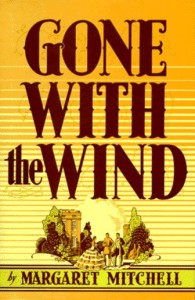
Would you rather have one smash hit, or a long series of good—if not mind-blowing—little hits? Robert McCrum asks that very question in The Observer: Original work is, by definition, exceptional. Often, it seems to come out of nowhere in a explosive flurry of excitement. Anglo-American and European literature is notable for its sprinters as well as its long-distance runners. There are so many brilliant one-offs, especially at the more popular end of the business: Margaret Mitchell’s Gone With The Wind, or Harper Lee’s To Kill A Mockingbird, for example. Rosamond Lehmann had a long career, but most readers know […]


Shop Talk |

Literary Tees from Out-of-Print Clothing

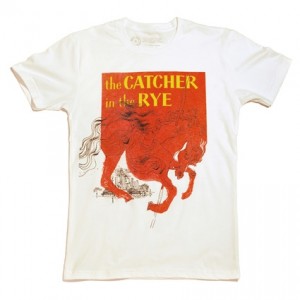
We’ve talked about literary T-shirts on the blog before, but here’s another combination of bookishness and fashion—plus a dose of do-goodery. Out of Print Clothing has a twofold mission: 1. Provide awesome T-shirts based on iconic book covers. 2. Help those with little or no access to literature by donating books to Africa: one book per T-shirt sold. Says the company’s website: For each shirt we sell, one book is donated to a community in need through our partner Books For Africa. How we read is changing as we move further into the digital age. It’s unclear what the role […]


Reviews |

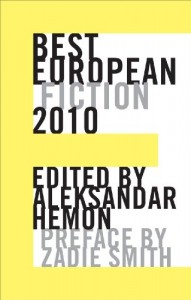
Best European Fiction 2010 (Aleksandar Hemon, ed.)

What is it about the European cultures, tucked like bats into their tiny cubbies, that seems so much more specific than our own? How do Belgium or Luxembourg achieve “culture” in little more space we might use to construct a Wal-Mart megastore? What is it about confinement that breeds a more tribal than national identity? What are we doing when we sit down to read a collection of fiction culled from a continent?