
Suspend Your Disbelief

Posts Tagged ‘recommended reading’

Shop Talk |

More on 20 Under 40 (and one over 80!)

The response to The New Yorker‘s “20 Under 40” list continues. Dan Wickett and Steven Gillis, co-founders of indie, non-profit publisher Dzanc Books, polled “nearly 100 independent publishers, agents, editors, bloggers and reviewers” to compile an alternate “20 to Watch” list—with no age limit: As the staff of The New Yorker went to the sources they knew best when creating their list, and most of the authors they reviewed have either been published in The New Yorker or with major New York publishing houses, so we focused on writers publishing with independent houses. We realize that our list reflects its […]

Shop Talk |

How to Cope with the Writing Life

Author Hannah Moskovitz has a sweet little post on coping with the ins and outs of a daily writing life: Here’s what I’ve found keeps you from getting gnawed down to nothing with the jealousy, fear, and guilt that seems to go hand in hand with writing. Tell someone who isn’t a writer. When I was querying in high school, I had a few people ask me why the fuck I kept running to the computers like an addict between every class. So I explained querying to them, with a flow-chart. All paths lead to rejection–query, partial, full–except this one […]


Shop Talk |

20 Under 40, 10 Over 80, and 20 More Under 40 (40 Years Ago)

Time for age-based writer lists! First up: The New Yorker names its list of “20 under 40” list of fiction writers worth watching. The last such list was compiled in 1999 and included Jhumpa Lahiri, Junot Diaz, and David Foster Wallace; the current list includes Sarah Shun-Lien Bynum, Joshua Ferris, Salvatore Scibona, and Wells Tower, among many others. Yes, all of them were born in 1970 or later. If that bothers you, move on to list #2: Ward Six counters the New Yorker list with a list of “10 Great Writers Over 80,” praising John Barth, Beverly Cleary, Harper Lee, […]


Shop Talk |

The Library of America's Story of the Week

Each week, The nonprofit Library of America offers a free short story, readable online in PDF form. The current “Story of the Week” is “The Charmed Life”< by Katherine Anne Porter. Other recent features include “Charles” by Shirley Jackson (who—yes!—wrote more than just “The Lottery”), the early story “The Cut-Glass Bowl” by F. Scott Fitzgerald, and The Wives of the Dead” by Nathaniel Hawthorne. Each story is also accompanied by some commentary that helps set the story in context. This seems like a great—and free—way to discover some lesser-known pieces by well-known American writers. See the current story and all […]


Shop Talk |

"This Book Made Me Want to Die"

Here’s a great blog post from FWR favorite Aryn Kyle, on writing “happy literature”: “You should write something happy,” people tell me, and I don’t understand. Happy like Anna Karenina? Happy like The Grapes of Wrath? Happy like Lolita or Catch-22 or Revolutionary Road? Happy like Hamlet? What, I’d like to ask people, are these “happy books” you speak of, and who is writing them? I was an English Literature major, for sobbing out loud! I’ve never read a happy book in my whole life! Unless you count Jane Austen, who could usually be depended on to wrap things up […]


Shop Talk |

Win a Copy of Short People, by Joshua Furst

We all had one. It’s one of those universals of human experience, more constant than love or rage or betrayal or grace. I’m talking about a childhood. Still, it’s impressively difficult to capture on the page, pitch the right tone, allow the perfect amount of insight and innocence, or describe the overblown drama of what it feels like to be a kid. From the opening story of his collection, Short People, Joshua Furst nails it. That first story, “The Age of Exploration,” follows the ramblings of Jason and Billy, best friends, both age six. Most of us can remember things […]


Shop Talk |

NPR's Three-Minute Fiction Contest, Round 4

May is Short Story Month, and what better way to celebrate than by reading some short fiction by emerging writers? But I don’t have time, you say. National Public Radio has the answer: three-minute fiction. These stories can all be read aloud in under three minutes—little gems to surprise and delight you in less time than it takes to microwave a bag of popcorn. The deadline for the current round NPR’sThree-Minute Fiction Contest has passed, but while judge Ann Patchett decides on the winner, check out some of the entries. All stories for this round include the words “plant,” “trick,” […]


Shop Talk |

Tim O'Brien-arama

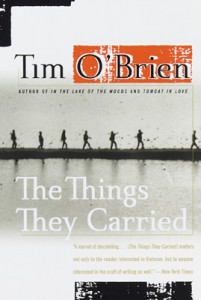
The classic The Things They Carried is being re-released in honor of its 20th anniversary, so unsurprisingly, Tim O’Brien keeps popping up in my radar lately. Besides being a powerful writer, O’Brien is also a great teacher, and in his recent interviews he offers useful thoughts for writers of all levels. In this interview for Beyond the Margins (with Grub Street program manager Sonya Larson), O’Brien discusses the writing of The Things They Carried, how being a father changed his writing, and recent literary works by soldiers stationed in Iraq and Afghanistan: I have read a number of books and […]


Shop Talk |

The Case Against Writing Manuals

In The Atlantic‘s 2010 Fiction issue, Richard Bausch makes a powerful argument against writing manuals: Now, I’m not speaking about books dealing with the aesthetics of the task, or with essays about the craft and critical analysis of examples of it—and we have several very fine volumes in that vein (Charles Baxter’s Burning Down the House and John Gardner’s The Art of Fiction come to mind)—no, I’m talking about straight how-to books, most of which claimed to offer shortcut advice, practical instructions on “writing your say the genre,” and even in some cases “secrets” of the novelist’s or story writer’s […]


Shop Talk |

Dating Advice as Writing Advice

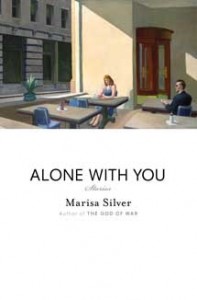
Over at The Elegant Variation, Marisa Silver guest blogs, drawing some parallels between love and writing: On love: 3. You will never know your partner. 4. You should never know your partner. 5. You will never know how things will end up. On writing: 3. People will ask you what your work means and you will try to explain it to them, but you won’t really be able to explain it even if it sounds like you are saying something intelligent. 4. You should not be able to explain it. There should always be something ineffable and mysterious about it, […]