Posts Tagged ‘Michael Rudin’

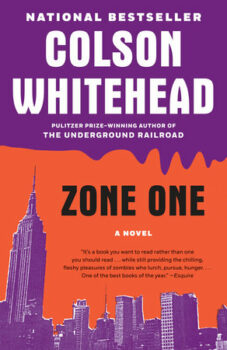
The Forbidden Thought: A review of <em>Zone One</em>, by Colson Whitehead

The Forbidden Thought: A review of Zone One, by Colson Whitehead

We celebrate Valentine’s Day with an homage to the living dead: Colson Whitehead’s Zone One. Don’t fancy a date with scary slavering? No matter. Michael Rudin finds the novel reads like an existential valentine to New York City, and that’s something even a zombie can love.

Journal of the Week: <em>The Georgia Review</em>

Journal of the Week: The Georgia Review

Our latest Journal of the Week, The Georgia Review, has been committed to storytelling since its founding in 1947. Heading toward its 258th issue, the journal’s careful curating of stories, essays, poetry, reviews and art has helped it survive the test of time—and flourish.

Journal of the Week: <em>A Public Space</em>

Journal of the Week: A Public Space

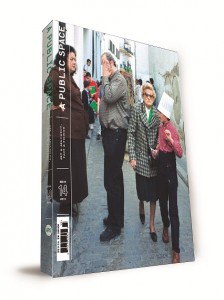
Our latest Journal of the Week, A Public Space, strives to be “a literary forum for the stories behind the news, a fragment of an overheard conversation, a peek at the novel the person next to you on the subway is reading, the life you invent for the man in front of you at the supermarket checkout line. Ideas and stories about the things that confront us, amuse us, confound us, intrigue us.”

Journal of the Week: <em>Hobart</em>

Journal of the Week: Hobart

Michael Rudin presents Hobart, our latest Journal of the Week. The journal’s ability to curate badass, cutting-edge narratives has helped this modest upstart grow out of Founding Editor Aaron Burch’s bedroom into a full-on web/print literary journal and publisher.

Get Writing: Steal on the First Pitch

Get Writing: Steal on the First Pitch

In our “Get Writing” series, we share some of our favorite exercises for classroom (or personal) use. Enjoy!

You’ve played your most inspirational music. You’ve flipped through your most weathered paperback. You’ve stood on your head, gone on a jog and even cleaned your apartment.
Twice.
But if that first sentence just isn’t coming to you, don’t [...]

Journal of the Week: PANK

Journal of the Week: PANK

The stories in PANK epitomize their founders’ spirit of innovation, and it’s this spirit that has quickly helped build the journal a loyal community. Read on to learn more about how the journal provides inspiration for writers and readers alike.

Journal of the Week: <em>American Short Fiction</em>

Journal of the Week: American Short Fiction

In the end, I don’t have many literary magazines because I give most away. Leaving them at coffee shops and airports, with friends and family, I pay my journals forward, margin notes and all.
But I kept American Short Fiction Volume 13, Issue 47.
My experience with #47 began with its second-to-last-story—a sin the editors must forgive [...]

Stories We Love: "Refresh, Refresh"

Stories We Love: “Refresh, Refresh”

I’ve fought close to a dozen fights.
I’ve fought my brother, two best friends, five or so drunks in college, and a few New Years Eves ago, a group of six with one Australian and two Samoans at my side. It was the broad-shouldered Australian who began things by tapping my shoulder and informing me, [...]

Journal of the Week subscription winners: <em>The Missouri Review</em>

Journal of the Week subscription winners: The Missouri Review

We’re delighted to announce the winners of our Missouri Review Journal of the Week giveaway, chosen at random from our Twitter followers.
Congratulations to:

Nathan Golden (@nathgolden)
Robert Yune (@robertyune)
Spirit Authors (@SpiritAuthors)

You’ll each receive a complimentary one-year subscription to The Missouri Review! Please contact us at winners [at] fictionwritersreview.com with your contact information and we’ll coordinate [...]

<em>Best of the Web 2010</em>, edited by Kathy Fish and Matt Bell

Best of the Web 2010, edited by Kathy Fish and Matt Bell

Our history with print’s first-rate publications can be a comforting force, a grid of familiar local streets against the sand-swept dunes of online. And it’s this lack of familiarity with digital’s landscape that makes Dzanc’s anthology so incredibly necessary: for new and old writers alike, it’s a guidebook as much as it is a book-book.