Suspend Your Disbelief

Recent Posts

Shop Talk |

CLMP's 11th Annual Lit Mag Marathon Weekend

NYC-based readers: On June 19-20, check out the CLMP’s Lit Mag Marathon Weekend, an annual celebration, showcase, and discount extravaganza of literary magazines and journals. – Events kick off on Saturday at 4 PM with The Magathon at the New York Public Library (main branch: Fifth Ave @ 42nd Street). For 2.5 hours, a number of journal editors will present favorite selections from their latest issues. – Then on Sunday from noon to 5, get your discounted periodical fix at the 11th Annual Literary Magazine Fair (also known as the Giant Lit Mag Fair) at Housing Works Bookstore Café (126 […]
Shop Talk |

"This Book Made Me Want to Die"

Here’s a great blog post from FWR favorite Aryn Kyle, on writing “happy literature”: “You should write something happy,” people tell me, and I don’t understand. Happy like Anna Karenina? Happy like The Grapes of Wrath? Happy like Lolita or Catch-22 or Revolutionary Road? Happy like Hamlet? What, I’d like to ask people, are these “happy books” you speak of, and who is writing them? I was an English Literature major, for sobbing out loud! I’ve never read a happy book in my whole life! Unless you count Jane Austen, who could usually be depended on to wrap things up […]


Interviews |

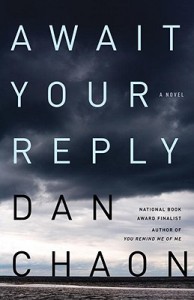
Unanswered Questions: An Interview with Dan Chaon

“I’ve always felt personally and emotionally closer to the searchers, rather than to the finders…to those who don’t get answers, as opposed to those who do. For me, the experience of epiclitus is closely related to the experience of the uncanny, but also to the experience of complex and problematic emotions, like yearning, and awe, and psychic unease, which are of particular interest to me. That precipice of endless uncertainty, of the impenetrable—those are the moments that I’ve always loved in literature, as well as the moments that have haunted me in life.”


Shop Talk |

Is it better to burn out, or fade away?

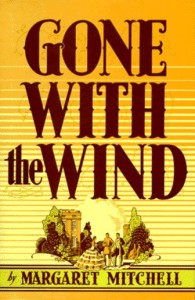
Would you rather have one smash hit, or a long series of good—if not mind-blowing—little hits? Robert McCrum asks that very question in The Observer: Original work is, by definition, exceptional. Often, it seems to come out of nowhere in a explosive flurry of excitement. Anglo-American and European literature is notable for its sprinters as well as its long-distance runners. There are so many brilliant one-offs, especially at the more popular end of the business: Margaret Mitchell’s Gone With The Wind, or Harper Lee’s To Kill A Mockingbird, for example. Rosamond Lehmann had a long career, but most readers know […]


Shop Talk |

Literary Tees from Out-of-Print Clothing

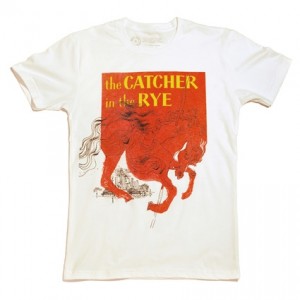
We’ve talked about literary T-shirts on the blog before, but here’s another combination of bookishness and fashion—plus a dose of do-goodery. Out of Print Clothing has a twofold mission: 1. Provide awesome T-shirts based on iconic book covers. 2. Help those with little or no access to literature by donating books to Africa: one book per T-shirt sold. Says the company’s website: For each shirt we sell, one book is donated to a community in need through our partner Books For Africa. How we read is changing as we move further into the digital age. It’s unclear what the role […]


Reviews |

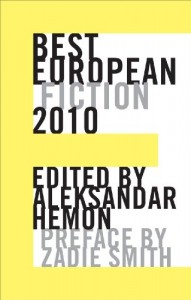
Best European Fiction 2010 (Aleksandar Hemon, ed.)

What is it about the European cultures, tucked like bats into their tiny cubbies, that seems so much more specific than our own? How do Belgium or Luxembourg achieve “culture” in little more space we might use to construct a Wal-Mart megastore? What is it about confinement that breeds a more tribal than national identity? What are we doing when we sit down to read a collection of fiction culled from a continent?


Shop Talk |

Big Think: Lionel Shriver on the "Unwholesome" Side of MFA Programs

Should you get an MFA? On Big Think, novelist Lionel Shriver discusses the downsides of attending an MFA program: [It] does have a kind of indulgent, middle-class gestalt. The grim truth is that most people who get MFAs will not go on to be professional writers and therefore when I’ve been on the other side of it and occasionally taught creative writing, I felt a little bit guilty because so many of the people that you should be encouraging, because there’s no point to it if you’re not encouraging, are not going to make it. And I think that’s true […]


Shop Talk |

"…just another boring little middle-class boy hustling his way to the top."

That’s what Gore Vidal had to say about John Updike in 2008. Think that’s bad? Examiner.com’s Michelle Kerns has compiled the 50 best author vs. author put-downs, and Vidal’s comment is just the proverbial tip of the iceberg. Nathaniel Hawthorne called Edward Bulwer-Lytton “the very pimple of the age’s humbug.” James Gould Cozzens declared, “I can’t read ten pages of Steinbeck without throwing up.” Faulkner called Twain “a hack writer who would not have been considered fourth rate in Europe.” Read the rest at Examiner.com, and don’t miss Part 2, where Evelyn Waugh wonders if Proust was “mentally defective” and […]


Shop Talk |

Glass Wave: Lit-Inspired Music

Ever wonder what happens when literary professors make music? Glass Wave is what happens. Composed of four literary scholars—Thomas Harrison of UCLA and Robert Pogue Harrison, Dan Edelstein, and Christy Wampole of Stanford—plus drummer Colin Camarillo, Glass Wave has just released its first, self-titled album, with songs based on canonical Western literature. Inside Higher Ed profiles the band and the album: The 11-track album adapts themes and narratives from Homer, Ovid, Shakespeare, Herman Melville, Mary Shelley, Edgar Allan Poe, and Vladimir Nabokov, and sets them to musical compositions, generally in the vein of 1960s and ’70s progressive rock typified by […]


Shop Talk |

So, What's Really Killing Fiction?

You may have already seen this essay by Ted Genoways, editor of the Virginia Quarterly Review, blaming too many MFA programs and their “navel-gazing” writers for the sorry state of fiction these days: But the less commercially viable fiction became, the less it seemed to concern itself with its audience, which in turn made it less commercial, until, like a dying star, it seems on the verge of implosion. Indeed, most American writers seem to have forgotten how to write about big issues—as if giving two shits about the world has gotten crushed under the boot sole of postmodernism. Now, […]