Suspend Your Disbelief

Recent Posts

Shop Talk |

mind your manners

Did you learn your manners from reading Victorian novels? I find this scientific study fascinating…but I’d argue that if novels like Pride and Prejudice teach us how to behave as a society, they also beg us to misbehave, or at least to deviate from a “normal” path (and thank god!). Excerpt from a Telegraph.co.uk article (thanks, Tori!): Researchers believe the novels act like “social glue”, providing instructions on how society should behave. In particular they believe that the novel reinforces beliefs that maintain the community and warn against destructive influences and character traits. The study suggests that good literature “could […]


Shop Talk |

how to read 462 books in 365 days

How many books, on average, do you read a year? I thought I was a pretty voracious reader; in 2008 I finished 68 new books (this doesn’t include any books I re-read or manuscripts I read/edited for employers or friends). But, oh, I am outdone! Writer-reviewer Sarah Weinman (and a host of others who commented on her article) can read 462 books in one year; according to Weinman, the quality of her reading experience isn’t suffering, and she isn’t just skimming. Taking in this article, I was suddenly three feet tall in corduroy overalls, standing on tip-toes to ask my […]


Shop Talk |

gimme fiction!

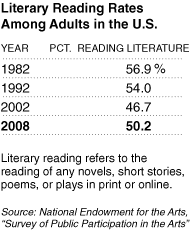
According to a new report by the NEA (“Reading on the Rise: A New Chapter in American Literacy”), the percentage of US adults reading fiction is growing for the first time in a quarter-century (chart borrowed from the NY Times). But I’m not ready to hit the street with pom-poms and a marching band just yet: a higher percentage of Americans were reading literature in the late 20th century–and it kind of blows my mind that only 50.2% of my fellow citizens have read even one novel, short story, poem, or play in the past year…


Shop Talk |

recommended reading: Nami Mun at B&N-Tribeca (NYC) on 1/12

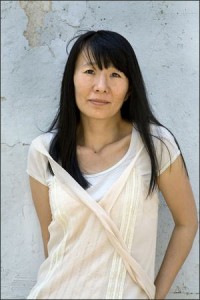
Join me tomorrow night at Barnes & Noble in Tribeca (97 Warren St. @ Greenwich St.) at 7 PM to hear Pushcart- and Hopwood-prize-winning Nami Mun read from her debut novel, Miles From Nowhere. And look for an interview (soon!) with Nami on FWR. Miles from Nowhere began as a collection of linked stories (two of which I had the pleasure to read in workshop at Michigan, and several of which have been published in prestigious lit journals). As a novel, it holds together beautifully; Miles remains episodic, but breaks between chapters feel hauntingly like lost years–perfect for this particular […]


Shop Talk |

recommended reading: Allison Amend at T&W Collective (NYC) on 1/21

I go to a lot of readings. It’s a rare week when I don’t attend at least one or two. And while I’d say I enjoy them in the abstract, I have to admit that too often, even when I love the writer, I wind up kind of bored or restless: I think about my own writing, or I agonize over that leaning tower of laundry back home, an unfinished freelance project, the friend whose novel draft I *still* haven’t finished reading, whether my water bottle is slowly emptying into my sad, overstuffed purse… Not so with the One-Story reading […]


Shop Talk |

"Move over, Oprah," says book club for story collections

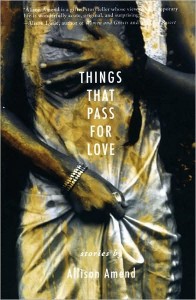
Writer-blogger Andrew Scott has started Andrew’s Book Club, which recommends two story collections every month, one from a mainstream publisher and one from an independent press; Andrew encourages all book club members to buy at least one of these two books each month, investing in twelve collections each year. His January picks are Lauren Groff’s Delicate, Edible Birds and Allison Amend’s Things That Pass for Love. Andrew’s Book Club offers a blog, a Facebook site, and a mission: to boost sales of the collections Andrew endorses; to boost sales of story collections, period; and to encourage discussion of the books […]


Reviews |

An Arsonist's Guide to Writers' Homes in New England, by Brock Clarke

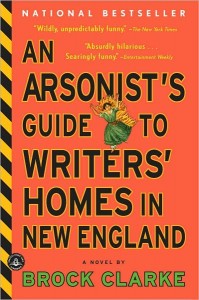
I don’t actually want to tell you anything about this novel. I want you to go read it and then meet me at Sweetwaters in Ann Arbor, so we can talk about our favorite parts while sipping mocha lattes and nibbling cranberry scones. This type of behavior—informally discussing books in settings seemingly created for the informal discussion of books—is something that Clarke makes fun of in the novel, but then again, he makes fun of pretty much anyone who likes books, or talks about books, or thinks they are at all important. A significant feat, considering the fact that Clarke obviously reads tons of books, and loves them, and thinks they’re at least important enough to spend a few years writing a pretty good one.