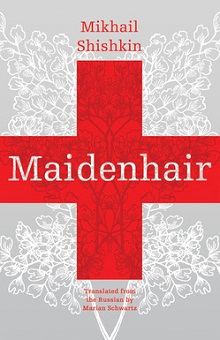
The Value of Naïveté: Shishkin’s Maidenhair in Russian and English
by Ian Ross Singleton
“There is an experience it implies, a weary worldliness with which many writers aspire to imbue their characters.”

“There is an experience it implies, a weary worldliness with which many writers aspire to imbue their characters.”

“Writing is nothing but entering the memories of the body”: Bulgarian writer Viriginia Zaharieva talks with Steven Wingate about her novel Nine Rabbits.

When meaning eludes us, we add and subtract, stack and build, until we’ve mosaicked our way deeper into the mystery.

Some of the most complex and weighty signifiers are brand names, celebrity names, clichés, and propagandist phrases like “axis of evil.” These categories overlap: celebrity names are brand names, brand names are propaganda, propaganda is cliché, etc. “Axis of evil” is a place to start because of its obviousness. No educated person I have met can vocalize this phrase without quotation marks implicit in the vocal texture. What do these quotation marks mean? I think they mean we don’t wish anyone to think we are complicit with the ideology behind the phrase. We use quotation marks to indicate awareness of […]

Nina Buckless talks to Nicholas Delbanco about talent, genius, and the work of “lastingness.”
“I wanted the reader to feel wounded that these souls had been taken from us,” Patrick Hicks says of the minor characters in his new novel, The Commandant of Lubizec.
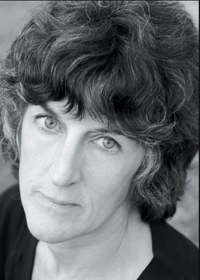
Editor’s Note: The Hopwood Room Roundtable is a weekly event in which visiting writers of the Helen Zell MFA Program in Creative Writing discuss their work and the writing life with the University of Michigan’s student body, faculty, and the local literary community. Despite the ongoing gloom of this Midwestern winter, Kathryn Davis filled the Hopwood room with writers eager to ask her questions. Davis told us that she loves answering reader questions. “You never know what somebody’s going to ask you.” It seems simple now to write this out, but I suppose you never know what you really think […]
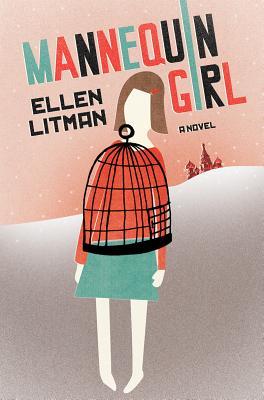
Mannequin Girl, Ellen Litman’s second novel, is a coming-of-age story and a family drama set in a Moscow boarding school for children with scoliosis.

Kim Church told me she was writing a novel titled Byrd the first time we met. We were at the Virginia Center for the Creative Arts (VCCA) in Amherst, walking a lane after dinner, cows grazing in the adjacent pasture. I’m sure I heard “Bird” even when it became clear that Byrd is a character. The surprise of homonyms captured me. “This novel,” I thought, “will be poetry.” Now, four years later, the novel is almost out; I have read the galley and, I’m thrilled to say, I was right. Sparse and complex, Byrd (Dzanc Books, 2014) makes rich use of extended […]
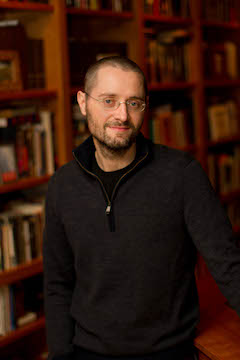
A writer can never have too much (or too little) advice on how to handle rejection. Every rejection, no matter how discrete, invokes the sensation of being punched in the face, and it’s extremely difficult to be magnanimous while that’s going on. So here’s my advice: with a slight shift in perspective, it’s possible to find rejection thrilling. The first step is learning how to take a punch. (Having been raised in a boxing family, I acquired this knowledge early in life.) The second step is learning how to enjoy taking a punch. That’s the hard part. Once my debut […]