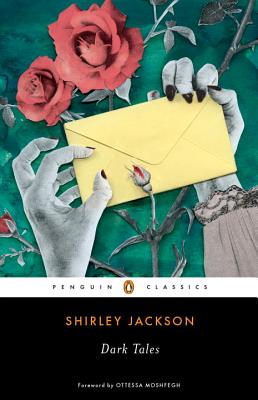
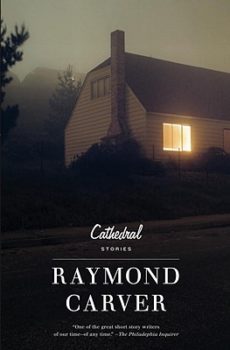
Vichyssoise / Poached Salmon, Served Cold with Citrus Mayonnaise / Homemade White Wine Fish Stock / Grilled Asparagus with Rosemary / Mango Ice Cream with Raspberry Coulis
“We begin eating, with enthusiasm. The risotto is slippery and mild, the squash is sweet, the chicken is swimming in butter. It makes me want to cry, it’s so good.” — from The Time Traveler’s Wife
“Every now and then go away, have a little relaxation, for when you come back to your work your judgment will be surer. Go some distance away because then the work appears smaller, and more of it can be taken in at a glance, and a lack of harmony and proportion is more readily seen.” — Leonardo da Vinci
According to Harvard anthropologist Richard Wrangham, cooking is one of the things that makes us human. I would argue another important thing on that list is storytelling. Perhaps this is why good stories so often involve food.
Today is the debut of Novel Dishes, a new occasional series on Fiction Writers Review.
“You take up the pen when you are told, and write what is commanded.”
— Zora Neale Hurston
Consider Hurston’s words in the context of note-taking and revision, which we normally don’t think of as particularly inspired phases of the fiction process. Preparing the canvas can be a long and dreadful bore; we learn about our characters in slow motion, wanting to write the work itself but knowing that we aren’t yet ready. We synopsize, sometimes outline, sometimes take copious notes that we then ignore completely.
Ptolemy was trying to describe a system that didn’t exist. His point of view, literally, was wrong. He wasn’t looking at the planets from a fixed center, but from a body that was itself circling the sun. Copernicus’ eventual understanding of this fact led swiftly to the discovery of several other beautiful truths, including those of Kepler, Brahe, and Newton – suggesting that where you stand has everything to do with what you can see. And that if you’re standing in the wrong place, or facing the wrong direction, you’re going to see a very strange, distorted view.
All of which is to say, point of view matters. It might be proposed that an author does well to be relatively Copernican, even if his characters start out almost entirely Ptolemaic. … The supreme example of a character remaining Ptolemaic within a Copernican story is Chekhov’s “Lady with the Pet Dog”. In this story, Chekhov knows nearly everything, and Anna knows, perhaps, only a little less – while the point of view character Gurov knows almost nothing of what goes on around him.
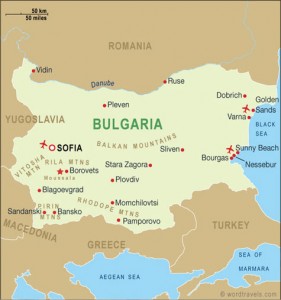
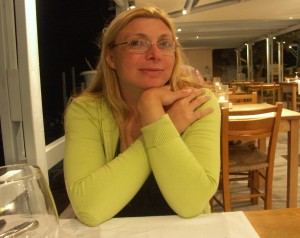
Each year the Elizabeth Kostova Foundation selects five native English speaking (NES) writers and five Bulgarian writers to participate in the Sozopol Fiction Seminar, which takes places in the tiny, historic town of Sozopol, Bulgaria, on the Black Sea. And this summer I was lucky enough to be chosen as one of the NES fellows.It was, in a word, amazing. And though I’m by no means a photographer, I hope that a few of these snapshots might begin to capture the experience of being in such a unique place with so many generous and talented individuals.
“Do not imagine you can exorcise what oppresses you in life by giving vent to it in art.”
–Gustave Flaubert
Practitioners of fiction may find this Flaubert quote hard to embrace, because if we’re honest with ourselves we’ll probably have to make some difficult admissions. Many of us—especially those who fell in love with the craft early, perhaps under the spell of Austen or Kerouac or Salinger—embarked on the fiction endeavor with an eye toward self-discovery. Most writers started writing because we found ourselves immersed in the character-self vortex as readers, identifying with fictional characters so intensely (as we searched for ourselves in them) that it became second nature to live in their worlds. From there it’s a small but decisive step to the other side of the formula: entering into the vortex as a writer and deciding to participate in literature as a transmitter of emotional signals rather than as a receiver alone…
At Sewanee everyone mingled with everyone else—poets with playwrights with fiction writers, famous and not, published and not, emerging or well established. It didn’t matter. Therefore, when it was Andrew Hudgins’ turn to give a craft lecture, I was one of the first to go, eager to absorb what I could smuggle back to those students in my undergraduate workshop who had more of an ear for poetry than me, their fiction-writing professor. I needed to be at that lecture for professional obligations; I wanted to be there for personal desires. But just as I was beginning to reach towards the trellises of poetic symmetry, grasping for that hanging fruit, I heard Hudgins say, a mocking lilt to his voice, “…and then he became a fiction writer, like all failed poets tend to do.”
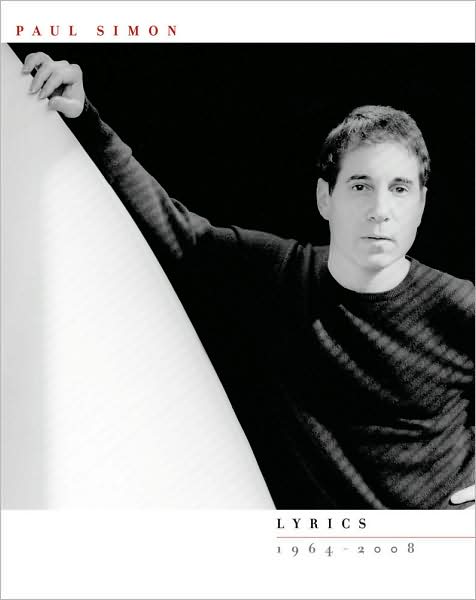
Lyrics 1964-2008 (Simon & Schuster, Nov. 2008), the first collection of every word to every song Paul Simon has written in the past forty-four years, reads like a collection of short-stories, something reminiscent of Grace Paley or Richard Ford.
Let’s face it: fiction writers do not have a reputation for being carefree, untroubled souls. Even
our fellow artists consider us broody navel-gazers who are overly introspective and perhaps even in love with our own problems. (We do, after all, tend to keep writing about characters whose psychic profiles overlap significantly with ours.) The general public is hardly more charitable, usually assuming that (a) we study them to gather material, or (b) we all write thinly-veiled autobiography, and are so blind as to not even be aware of it. Do we deserve assessments like these? Probably so…
I do not fear for literature, which has endured purges of all kinds, the death of the novel, the irrelevance of poetry, centuries without general literacy, and every other threat that has been hurled its way. Enough people hold it dear, and it is intrinsic enough to the human identity, for it to survive whatever problems plague it now. But I do fear for those young writers whose primary teaching in their craft is market-centered rather than literature-centered.