
Suspend Your Disbelief

Recent Posts

Shop Talk |

The Rise of the "Jumper Colon"

As a former professional proofreader, self-proclaimed punctuation nerd, and admitted colon addict, I was delighted to stumble across Conor J. Dillon’s essay on the uses of colons in prose. The whole thing is worth quoting, but here’s a snippet: A new colon is on the march. For now let’s call it the “jumper colon”. For grammarians, it’s a dependent clause + colon + just about anything, incorporating any and all elements of the other four colons, yet differing crucially in that its pre-colon segment is always a dependent clause. (Yikes.) For everyone else: its usefulness lies in that it lifts […]

Shop Talk |

I hope this submission leaves you in a condition of uncontrolled and irreversible “wow.”

Want to learn what not to put in your query letter? Or maybe you just can’t get enough #queryfail? A self-proclaimed “grumpy literary agent” has started SlushPile Hell, a Tumblr blog dedicated to terrible author queries he (or she) has received—plus snarky commentary. Here’s a quick sampling: Greetings agent. I have written the most important book on earth. Will someone, for the love of God, please kill me. Hello. I’ve queried more than 50 other agents with this and have gotten nowhere. Now I’m querying you. You had me at hello. I’M TYPING MY QUERY IN ALL CAPS SO YOU […]


Shop Talk |

Congratulations. (Except I hate you.)

I have always thought that freudenschade should be a word. Definition: feeling bad when good things happen to other people. Apparently The Rejectionist agrees. A recent essay gives some advice on what to do when good things happen to bad people: No, today we wish to discuss the cretin of all cretins, the foulest of asshats: the person who is not only talentless but LOATHSOME. Maybe it is that jerkwad from your critique group who says useless, mean things about everyone else’s work while his own stories are thirty-page expository accounts of his erotic escapades! Maybe, for the agents among […]


Shop Talk |

The Challenges of Digital Typesetting

Abu Dhabi’s The National offers this fascinating piece by Peter Robins about typesetting ebooks: “Designing a printed book is remarkably different from designing an ebook,” says Charles Nix, a partner in the New York publishing firm Scott & Nix and the president of the Type Directors’ Club. “Printed-book design is about fixed-size pages and spreads. Those are gone in ebooks. Book designers choose typefaces and point sizes to maximize legibility and comprehension. Those are gone in ebooks too. Some formats, he notes, do allow you to embed a font, but you can’t rely on reading devices picking it up. Book […]


Interviews |

Starting with Small Moments: An Interview with Andrew Porter

Polly Atwell talks with Andrew Porter about how crafting stories is like editing film, what particular advantages peripheral narrators can afford, and why it’s “completely surreal” to hear actors read from your work.


Shop Talk |

Can Kickstarter fund a lit website?

With print media slashing book sections, the future of book reviews may well be online. (Case in point: this site.) But like print media, websites cost money to run. So what’s a book review site to do? In the Stacks, a video book reviewing site, has one solution: use the community fundraising site Kickstarter to raise money. Author and site founder Michelle Zaffino writes: Last year I created the program In the Stacks video book review (www.inthestacks.tv), which features 60-second long reviews of recent books. The reviews are done by one of the most authoritative sources on the topic: Librarians. […]


Shop Talk |

Real-Life Characters in Fiction

Erika at Practicing Writing pointed us to this great post at The Guardian on real-life characters in fiction. Writes blogger Meg Rosoff: Six hundred words were suggested to tackle the important question of whether it is “right and fair” to fictionalise real-life characters. I could answer it in 15. Do what you like, only do it well – and don’t expect the relatives to approve. The possibilities for intersecting “real life” and fiction are many. Some works, like E. L. Doctorow’s Ragtime sprinkle real-life personnages across their pages; others, like Hilary Mantel’s Booker Prize–winning Wolf Hall, base the story upon […]


Shop Talk |

Recently on FWR…

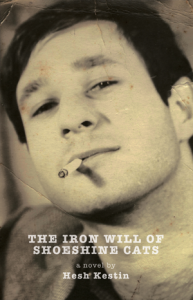
Hiding out from the heat wave this weekend? Here’s the perfect reading material while you seek out some A/C: FWR’s features from the past two weeks, including three reviews of debut novels and an interview with a veteran: Michael Rudin reviews Hesh Kestin’s The Iron Will of Shoeshine Cats, observing: In the end, Iron Will isn’t about denial, it’s about confrontation. The confrontation of a Jewish people against the hardships they faced in World War II—“In melting-pot America [Jews] were heat-resistant, tempered by several thousand years of being close to, if not in, history’s fires”—just as it is about the […]


Shop Talk |

Trailer as Logical Argument

The book trailer is a relatively new phenomenon, but innovation has quickly become the rule. Take the trailer for Gary Shteyngart’s new novel, Super Sad True Love Story, which features cameos by James Franco (a former MFA student of Shteyngart at Columbia), Jay McInerney, Edmund White, Mary Gaitskill, and Jeffrey Eugenides. It’s tongue-in-cheek, as to be expected from the author of The Russian Debutante’s Handbook, and contains some very funny non sequiturs – like how to blend in at a Paris Review party – and I knew virtually nothing about the book by the end. But conveying actual information is […]


Reviews |

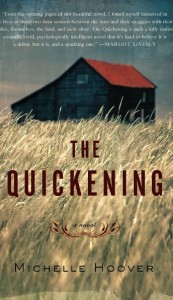
The Quickening, by Michelle Hoover

Every work of fiction is grown from at least one seed of truth, whether it’s an emotional truth, an actual event, or a fact of nature. For Michelle Hoover, author of the elegant debut novel The Quickening, this seed was a fifteen-page document that her great-grandmother typed out in the final year of her life. In it, “broken hearted and sick in mind and body,” she recounted her seven decades as an Iowa farmwoman. Loosely based on this document and family oral histories, The Quickening follows the journeys of two Iowan families trying to build their lives amid the hardships of the Great Depression.