
Suspend Your Disbelief

Essays

Essays |

Quotes & Notes: Gotta Serve Somebody: Writers and Academic Homes

“Everywhere I go, I’m asked if the universities stifle writers. My opinion is that they don’t stifle enough of them.” — Flannery O’Connor

It’s hard to argue with your heroes, though it’s significantly easier after they’ve died. Flannery O’Connor—the first writer I wanted to be—refers in this quote to creative writing workshops, which were just becoming the new standard for writerly apprenticeship when she launched her career. But I don’t have the same issues as she had with the workshop paradigm as it’s now practiced, or with the proliferation of creative writing programs.

Essays |

Quotes & Notes: Best Shots and Shortcuts

“Always give your characters their best shot.” — Stuart M. Kaminsky

As writers, we can add on (and on) to the external details of a character, trying to make that person real in the way that Pinocchio hopes to become so. Theoretically, we might be able to acquire enough details in a personality inventory for our readers to accept our characters as convincing. But ultimately, as Stuart Kaminsky knew, this way of creating character doesn’t work because it’s the subtext of our characters’ lives that make them real. Using the “inventory” process to get to know them is fundamentally flawed because it makes us lazy.


Essays |

My Kindle, Myself

It was cold and white and looked not unlike a refrigerator for guinea pigs. It had far too many buttons. It stalled for an annoying millisecond when flipping between pages. There was no way I would ever be able to suspend my disbelief and fully enter the world of a book.

And then, somewhere over Georgia, I changed my mind.


Essays |

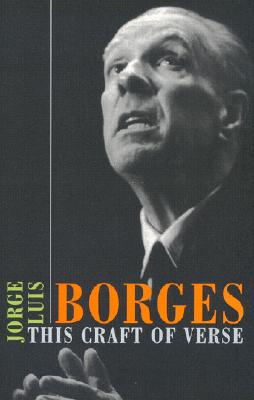
Magic and Music Steer this Vessel: On Jorge Luis Borges’s This Craft of Verse

In This Craft of Verse, Jorge Luis Borges’s collected Norton Lectures, Borges diverges–with sparkling erudition–from conventional forms, offering lectures that are not arguments, but gentle provocations. Remarkably, these visionary pieces were composed at a time when Borges was nearly blind. By this time, as editor Calin-Andrei Mihailescu writes in the book’s postscript, Borges could see “nothing more than an amorphous field of yellow.” We quickly learn, however, that his mind’s eye was as sharp and discerning as ever.


Essays |

Quotes & Notes: In Praise of Perpetual Self-Reinvention

“Every book I publish is an opportunity for me to reinvent myself as a writer.” — Steve Katz

The easy thing to do when we finish one writing project, the default thing, is to simply think about what we’re going to write next. Katz’s words, however, call us to engage in a deeper kind of reconsideration of ourselves, because what we write and who we are as writers are two crucially different things.


Essays |

Ron Currie, Jr., Reads: Postcard from Portland, Maine

Spring is wet in Maine. The rivers swell and roadways succumb. Driveways turn to mud pits and basements flood. We take it all in stride, because living here is worth such minor irritations.

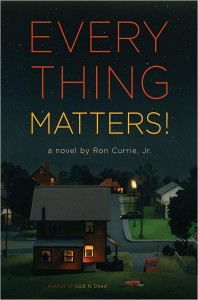
But this past spring, the rain seemed ceaseless. The normally bearable soggy months stretched into June and stole the beginning of summer from us. So, expecting Mainers to sit inside a bookstore on the first clear, balmy evening in early July seemed like too much to ask. Even the author Ron Currie, Jr., a Maine native himself, seemed hesitant to go inside Portland’s Longfellow Books for a reading and signing of his new novel Everything Matters! (Viking, 2009).


Essays |

Novel Dishes: The Time Traveler's Wife V: Henry's 43rd Birthday Feast

Henry: Lourdes brings small plates of exquisitely arranged antipasti: transparent prosciutto with pale yellow melon, mussels that are mild and smoky, slender strips of carrot and beet that taste of fennel and olive oil. We eat Nell’s beautiful rare tuna, braised with a sauce of tomatoes, apples and basil. We eat small salads full of radicchio and orange peppers and we eat little brown olives that remind me of a meal I ate with my mother in a hotel in Athens when I was very young. We drink Sauvignon Blanc, toasting each other repeatedly. (“To olives!” “To baby-sitters!” “To Nell!”). Nell emerges from the kitchen carrying a small flat white cake that blazes with candles. Clare, Nell, and Lourdes sing “Happy Birthday” to me. I made a wish and blow out all the candles in one breath. “That means you’ll get your wish,” says Nell, but mine is not a wish that can be granted.


Essays |

Novel Dishes: The Time Traveler's Wife IV: Recipes for Respite: Kimy's Sangria, Duck Breasts with Raspberry and Pink Peppercorn Sauce, and Almond Torte

Clare: “But don’t you think that it’s better to be extremely happy for a short while, even if you lose it, than to be just okay for your whole life?”

Richard DeTamble: “I’ve often wondered about that. Do you believe that?

Clare: “Yes, I do.”


Essays |

Hobbling Up The Magic Mountain

I just read Thomas Mann’s The Magic Mountain. The whole thing. Starting on page one and ending on page 706. The events in the book span seven years, and reading it seemed to take almost as long. When I embarked on this project, I was recovering from orthopedic surgery … Why, then, would I want to read a lengthy book packed with intellectual digressions set in a tuberculosis sanatorium in the Swiss Alps prior to the start of World War II? Hadn’t I been through enough? How about something light, or at least short? A Carol Goodman murder mystery, or something by Nick Hornby? As it turned out, The Magic Mountain was a choice so perfect I’m thinking a copy should be handed out with every pre-admission packet given to surgical patients…